
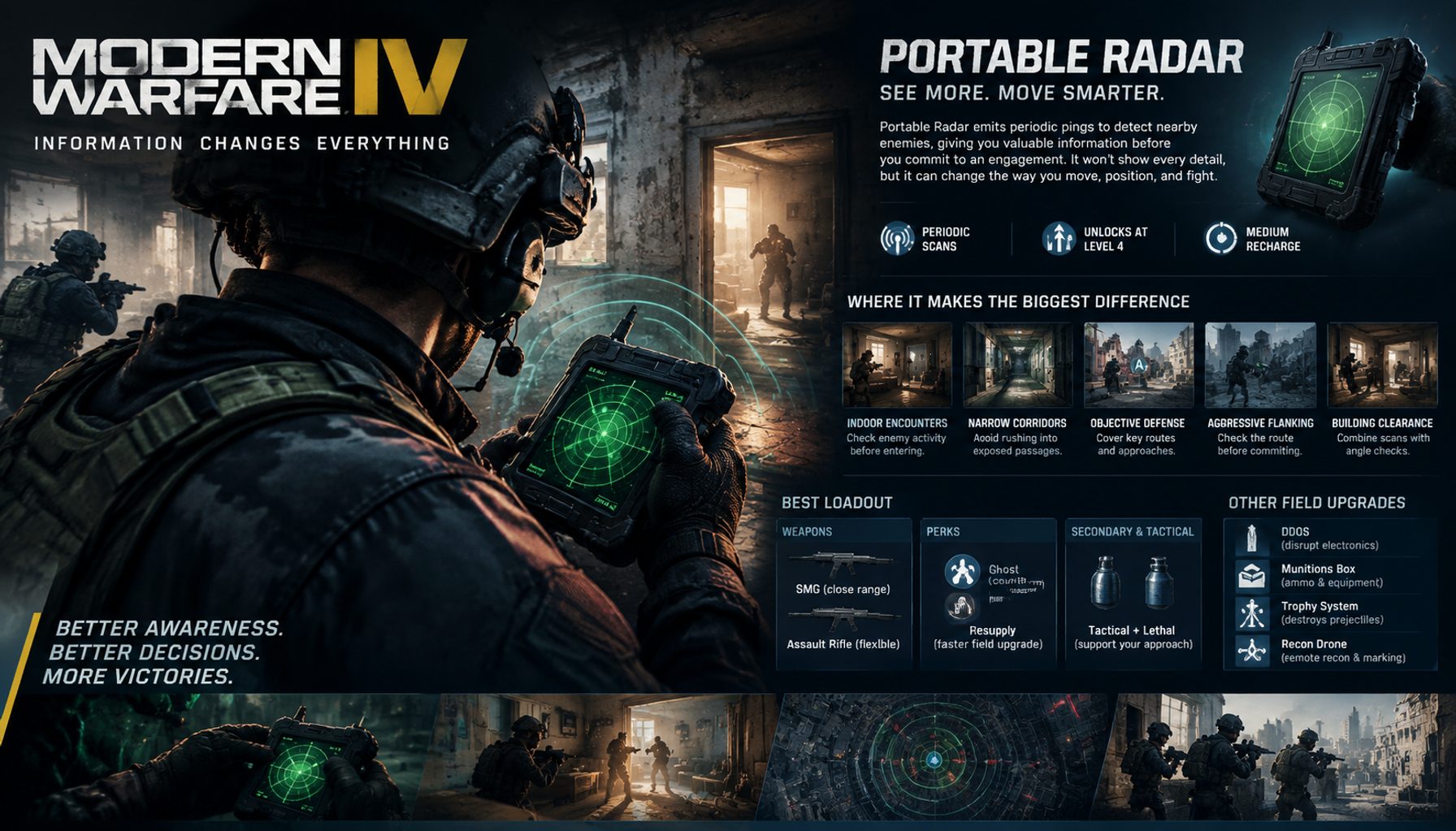
Close-range combat in Call of Duty: Modern Warfare 4 often begins before either player has a clear view of the opponent. A defender holding a doorway, an enemy moving between connected rooms, or an unexpected push toward an objective can quickly change the direction of an engagement. Reaction speed and weapon handling remain important, but knowing when and where an opponent might appear can provide an equally valuable advantage. Players can rehearse these situations in bot matches, with cheap MW4 Bot Lobbies providing a lower-pressure setting to practice movement, positioning, and approaches to contested areas. In regular multiplayer matches, Portable Radar adds another layer to these decisions by providing periodic information about nearby enemy activity.
How Portable Radar Changes the Pace of Close-Range Engagements
Portable Radar is a Field Upgrade that emits periodic radar pings to detect nearby enemies. It unlocks at Player Level 4 and has a Medium recharge speed, making it available relatively early in multiplayer progression. Its main strength lies in the information it provides before players commit to an engagement. Instead of relying entirely on visual contact or guessing where an opponent might be positioned, players gain another indication of nearby threats.
This can change the way players approach confined spaces. Consider an enemy holding a room behind a narrow entrance. Moving directly through the doorway gives the defender an opportunity to fire first, especially when the attacker has limited visibility. A radar ping indicating nearby enemy activity gives the approaching player a reason to reconsider the entry, check another route, or wait for a teammate. The equipment does not reveal every detail of an opponent’s position, but it can influence the decision before the first shot is fired.
The timing of these scans also affects how players manage their movement. Since Portable Radar operates periodically rather than providing uninterrupted detection, its information represents a snapshot of nearby activity. Players who understand this distinction can use a scan to prepare for their next move without assuming that an opponent will remain in the same location. This makes awareness and positioning more important, rather than replacing them with automatic detection.
Where Portable Radar Makes the Biggest Difference
The usefulness of Portable Radar becomes clearer when examining the environments where close-range encounters frequently occur. Buildings, narrow corridors, and objective areas all create different movement challenges. Each setting changes how players should interpret radar information and how quickly they need to respond.
| Combat Situation | Tactical Value | Recommended Approach |
|---|---|---|
| Indoor encounters | Provides additional awareness of nearby opponents | Check enemy activity before entering connected rooms |
| Narrow corridors | Helps players prepare for potential contact | Avoid rushing into exposed passages without checking the surroundings |
| Objective defense | Supports awareness around contested approaches | Position the device near routes that enemies are likely to use |
| Aggressive flanking | Helps evaluate nearby enemy presence | Check the intended route before committing to an attack |
| Building clearance | Adds information during room-to-room movement | Combine radar scans with careful angle checks |
Indoor combat is particularly suited to this equipment because buildings often contain several entrances and connecting rooms. Attackers must consider where defenders might be waiting, while defenders need to monitor potential approaches without exposing themselves unnecessarily. Portable Radar can help identify nearby enemy activity before an attacker enters a room, giving them more time to decide whether to challenge the position or change direction.
Narrow corridors create a different tactical problem. Their limited width restricts movement and makes it easier for defenders to hold predictable angles. An attacker who receives information about nearby enemies can prepare for a possible encounter instead of sprinting into the passage. Even when the scan does not provide an exact position, the warning can encourage a more controlled approach.
Objective defense introduces another important use. Players holding a Hardpoint or another contested position need to monitor several routes while remaining close enough to respond to incoming pressure. A Portable Radar placed near an important approach can provide additional awareness as the enemy team moves toward the objective. This information becomes more useful when teammates cover different entrances rather than concentrating on the same direction.
Choosing Weapons and Perks Around Portable Radar
Portable Radar becomes more effective when the rest of the loadout supports the way a player intends to move through the map. Weapon range, handling, and engagement distance all influence how useful nearby enemy information can be. Players looking for the Portable Radar best loadout in MW4 should consider the relationship between reconnaissance and weapon choice instead of treating each equipment slot as an independent decision.
SMGs are a natural pairing for players who frequently enter buildings and challenge opponents at short distances. Their role often involves quick movement, rapid target acquisition, and taking advantage of opportunities around corners or doorways. Portable Radar can help these players judge whether an aggressive push is worthwhile before entering an occupied area. When nearby threats are detected, they can prepare for close-range contact rather than relying entirely on reaction speed.
Assault rifles offer a different approach. Their flexibility allows players to handle both medium-range encounters and closer fights, making positioning especially important. Instead of constantly pushing into buildings, an assault rifle user may hold an angle near an entrance and use radar information to anticipate approaching opponents. This approach can be effective when controlling important routes or supporting teammates who are advancing toward an objective.
Perk selection also deserves attention. Ghost is particularly relevant because it makes players undetectable by enemy callouts, UAVs, Portable Radars, and Heartbeat Sensors. Its presence means Portable Radar users cannot assume that every nearby opponent will appear on their scans. Resupply offers another useful option by increasing Field Upgrade earn rate, allowing players to build around more frequent equipment use over the course of a match.
A balanced setup should consider several factors:
- Weapon compatibility: Select an SMG for frequent close-range engagements or an assault rifle for a more flexible approach.
- Movement strategy: Match the weapon’s strengths with the routes and positions where Portable Radar provides useful information.
- Perk selection: Consider Ghost when countering enemy reconnaissance and Resupply when building around Field Upgrade availability.
- Secondary equipment: Choose tactical and lethal equipment that supports the intended approach to buildings and contested positions.
- Team coordination: Share relevant information with teammates so they can prepare for threats from different directions.
The goal is to make every part of the loadout support a consistent playstyle. A player who prefers aggressive movement should be prepared to act on the information provided by Portable Radar, while someone who focuses on holding positions can use it to support defensive awareness.
Portable Radar Compared With Other Field Upgrades
Portable Radar is not the right choice for every match. Other Field Upgrades address different problems, and selecting one depends on whether the player needs enemy detection, electronic disruption, ammunition support, or protection from incoming projectiles.
| Field Upgrade | Primary Function | Most Suitable Situation |
|---|---|---|
| Portable Radar | Periodically detects nearby enemies | Preparing for close-range engagements |
| DDOS | Temporarily disrupts nearby enemy electronics and sensors | Countering electronic equipment |
| Munitions Box | Supplies ammunition and equipment to nearby teammates | Supporting extended engagements |
| Trophy System | Destroys incoming airborne projectiles | Protecting defensive positions and objectives |
| Recon Drone | Provides remote reconnaissance and enemy marking | Gathering information from a distance |
The main difference is the type of problem each upgrade addresses. Portable Radar focuses on nearby enemy detection, making it useful when players need information before entering a dangerous area. DDOS is more specialized, as its electronic disruption can help deal with enemy equipment and sensors. Trophy System serves a defensive role by intercepting incoming projectiles, which can be valuable when holding an exposed objective.
Munitions Box is more relevant during extended fights where ammunition and equipment supplies become a concern for the entire team. Recon Drone offers a different form of reconnaissance because players can control it remotely and use its marking capabilities to gather information beyond their immediate surroundings. Although both upgrades contribute to battlefield awareness, their deployment methods and tactical applications are different.
These choices should reflect the demands of the match. A player repeatedly entering buildings may benefit more from Portable Radar, while a teammate responsible for defending an objective under heavy explosive pressure may prefer Trophy System. Selecting equipment according to the team’s actual needs is more useful than following a fixed loadout recommendation.
Common Mistakes That Limit Portable Radar’s Effectiveness
Good equipment can still produce limited results when players use it without considering the surrounding situation. One frequent mistake is deploying Portable Radar too early, before reaching an area where enemy information can influence the next decision. If the battle moves elsewhere, the scans may provide little value when the player finally reaches the contested position.
Another mistake is remaining in the same location after detecting nearby enemies. A radar ping can indicate that opponents are close, but staying exposed while waiting for another scan gives them an opportunity to approach from a different direction. Players should use the information to reconsider their positioning rather than treating it as a reason to remain stationary.
Overreliance on radar information can also create problems. Portable Radar does not provide continuous tracking, and enemies can reposition between scans. Ghost further complicates detection because players using the Perk remain hidden from Portable Radar. As a result, an area that appears clear should never be treated as completely safe.
Players can avoid many of these problems by following a few practical habits:
- Deploy Portable Radar near routes that are important to the current objective.
- Reposition when enemy activity suggests that the current location has become dangerous.
- Continue checking corners, entrances, and surrounding movement instead of focusing entirely on radar information.
- Account for Ghost users when assessing whether an area is safe.
- Avoid wasting deployments in locations that are unlikely to see enemy activity.
These habits keep the equipment in its proper role. Portable Radar helps players make better-informed decisions, but map knowledge, movement discipline, and situational awareness still determine how successfully they handle an encounter.
How Portable Radar Supports Team Coordination
Portable Radar can influence more than individual gunfights when teammates use the information to coordinate their movement. In objective-based modes, players often need to defend several approaches at the same time. A teammate monitoring one entrance can provide information that allows another player to cover a different route or prepare for a possible flank.
This coordination is particularly useful when a team is trying to maintain control of a contested position. Without clear information, several players may react to the same visible threat while leaving another entrance unprotected. Radar information can help distribute attention more effectively, allowing teammates to respond according to their positions and responsibilities.
Aggressive teams can also benefit from this approach. Before challenging a defended building, players can use available reconnaissance to judge whether the attack needs additional support. One teammate might prepare to enter through the main entrance while another watches an alternative route. The resulting push becomes more organized because players have a clearer understanding of the surrounding situation.
Portable Radar still needs to work alongside communication and direct observation. Teammates should listen for audio cues, watch enemy movement, and adjust their positions as the match develops. Its information is most useful when everyone understands how it affects their responsibilities rather than simply reacting to individual radar pings.
Portable Radar Makes Preparation Part of Close-Range Combat
Portable Radar changes the way players approach close-range encounters by making information an important part of their preparation. Its periodic scans can support building clearance, objective defense, and aggressive movement, particularly in areas where limited visibility makes enemy positions difficult to judge. Although it cannot replace careful positioning or guarantee an advantage in every encounter, it gives players another way to assess nearby threats before committing to a fight.
Its Medium recharge speed and early unlock at Player Level 4 also make it a practical option throughout multiplayer progression. Players who understand its limitations can use it alongside suitable weapons and perks to develop a more consistent approach to combat. For those considering MW4 Boosting as part of their progression plans, faster access to unlocks can expand their available equipment choices, but familiarity with each upgrade remains important. Portable Radar ultimately earns its place through the decisions it helps players make: holding an angle, changing an approach, or preparing for an incoming opponent. These small adjustments can influence the pace of a close-range fight, giving players more control over how and when they engage.